
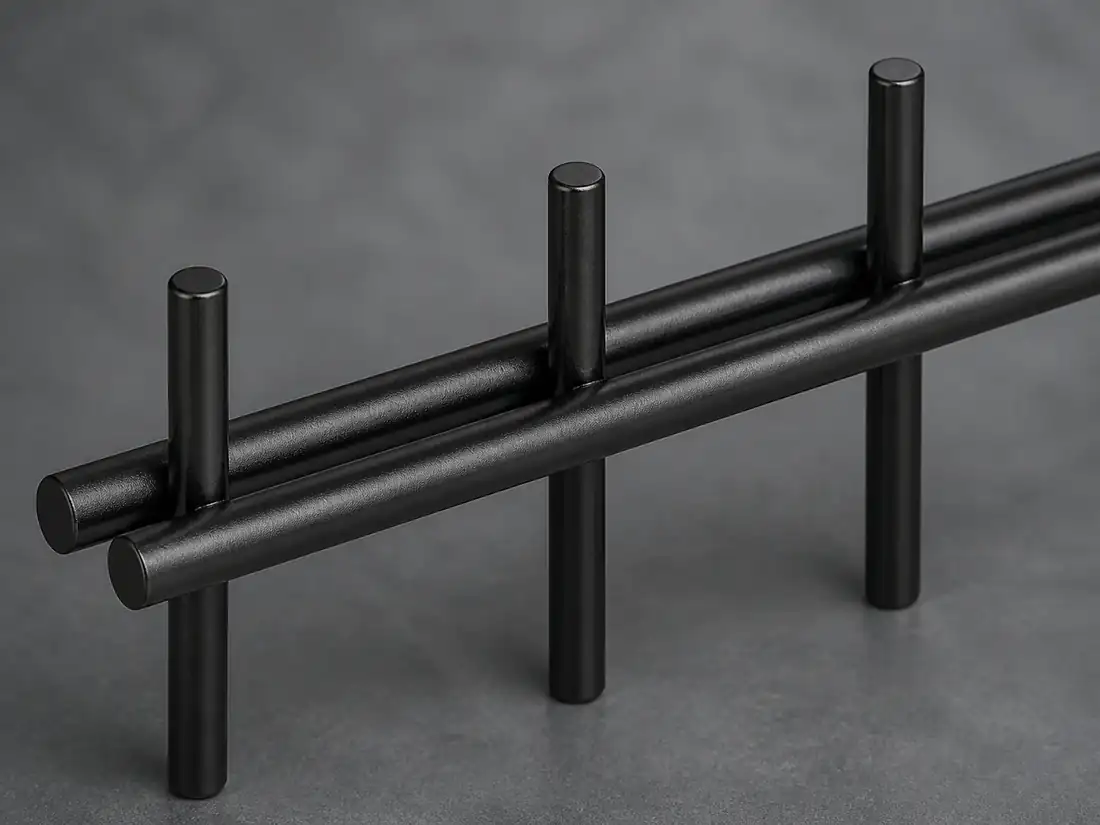
868 and 656 double wire fence panels use the same basic arrangement: one vertical wire is welded between two horizontal wires. The numbers describe the wire diameters, not a performance class. A buyer should compare the complete panel and support system rather than treating 868 and 656 as interchangeable product names.
What do 868 and 656 mean?
In common trade notation, 868 means two 8.0 mm horizontal wires with one 6.0 mm vertical wire. A 656 panel uses two 6.0 mm horizontal wires with one 5.0 mm vertical wire. Both constructions are commonly quoted with a 50 x 200 mm mesh, but the mesh, panel width and panel height must still appear in the purchase specification.
| Selection point | 868 double wire panel | 656 double wire panel |
|---|---|---|
| Horizontal wires | Two 8.0 mm wires | Two 6.0 mm wires |
| Vertical wire | One 6.0 mm wire | One 5.0 mm wire |
| Typical role | Heavier rigid boundary configuration | Lighter commercial boundary configuration |
| Mesh configuration | 50 x 200 mm commonly quoted | 50 x 200 mm commonly quoted |
| Panel width | 2500 mm typical AP option | 2500 mm typical AP option |
| Decision basis | Project loads, exposure, security objective and support system | Project loads, exposure, security objective and support system |
When the heavier wire arrangement matters
The paired horizontal wires give a double wire panel its characteristic rigidity. Moving from 656 to 868 increases wire mass and changes panel handling, post demand, fixing load and bundle weight. That can be useful where the project expects regular contact, a more rigid fence line or a heavier-duty boundary, but it should be an engineering and procurement decision rather than a default upgrade.
For schools, sports facilities, industrial sites and transport boundaries, the right choice depends on the risk assessment and installed system. A heavier panel on undersized posts is not a balanced specification. Equally, specifying 868 where 656 meets the project requirement can add weight and freight without solving another design problem.
Compare the panel as a manufactured component
The wire notation is only the first line of the schedule. Include the following in a comparable quotation:
- Nominal and permitted wire diameter after the agreed coating stage.
- Mesh aperture and panel dimensions.
- Edge-wire arrangement at the top and bottom of the panel.
- Weld, dimensional and visual inspection requirements.
- Metallic coating, powder coating, color and acceptance criteria.
- Bundle size, separator method and maximum handling weight.
ASTM F2919/F2919M covers specified categories of welded wire mesh fence fabric and addresses properties, dimensions, tolerances and workmanship. If this or another standard is required, state the exact designation and edition in the RFQ. Do not assume that the market terms 868 or 656 automatically establish compliance.
Posts, clips and bay planning
Post selection should be coordinated with panel height, panel width, fence-line geometry, exposure and mounting method. Square posts are commonly paired with double wire panels, using clips or clamp arrangements selected for the wire construction. The quotation should state the post profile, wall thickness, length, cap, hole pattern and fixing quantity per post.
Base-plated posts need a defined substrate and anchor design. Embedded posts need the required embedment and foundation information. These are project interfaces: the fence supplier can provide component dimensions, but the foundation and anchor suitability must be confirmed for the actual site.
Short bays, corners and changes in level should be shown on the drawing. If the layout is supplied only as a total length, suppliers may use different assumptions for standard bay count, cut panels and terminal posts, making the totals difficult to compare.
Finish and packing affect the delivered result
State the required coating sequence and color instead of writing only “green powder coated.” The RFQ should also identify whether coating thickness records, adhesion checks or other order-specific documents are required. The agreed inspection scope belongs in the order before production.
Double wire panels are heavy relative to many single-wire panels. They are normally stacked flat with separators and reinforced edge protection. Bundle weight, lifting method and container quantity should be calculated after the panel dimensions are approved. Ask for posts and clips to be identified by installation sequence when the project contains several heights or post types.
A practical 868/656 RFQ checklist
- State whether the required construction is 868 or 656 and write out the wire diameters.
- Provide mesh size, panel width, panel height, quantity or total fence length.
- Define post profile, centres and embedded or base-plated installation.
- List clips, bolts, caps, anchors, corner posts and terminal posts.
- Identify gates and required matching infill.
- Specify coating system, color and inspection documents.
- Provide the destination, handling limits and requested delivery sequence.
Common buyer questions
Is 868 always the better choice?
No. It is the heavier wire construction. The correct choice depends on the performance requirement, post system, site conditions, handling and budget.
Can 868 and 656 panels use the same posts?
Sometimes, but this should not be assumed. Confirm the panel height, post section, fixing layout and project loads as one system.
What information most often changes the final price?
Wire construction, panel dimensions, post and mounting system, finish, gate scope, bundle limits and destination all affect the quotation.
Review the AP Fencing 868 / 656 double wire fence system, then send the layout and preferred construction through the project RFQ. The quotation can separate panels, posts, fixings and gates so each supplier scope remains visible.
ASTM F2919/F2919M, Standard Specification for Welded Wire Mesh Fence Fabric. Applicability depends on the project specification and exact standard scope.